

It matters more than most people think. The material determines how the lash looks on the eye, how long it lasts, how it feels during wear, whether it is suitable for sensitive eyes, and how it aligns with your ethics around animal products. A lash labeled “mink” and one labeled “PBT fiber” can look similar in a product photo but behave very differently on the lash line.
This guide breaks down every material used in false lashes, from the fiber itself to the band and adhesive, so you can make a genuinely informed choice.
The Main Fiber Materials Used in Fake Lashes
1. Synthetic Fibers (Polyester and Nylon)
Synthetic lashes made from polyester or nylon are the most widely available and most affordable option on the market. They are manufactured at scale, which keeps costs low, and they hold their shape reliably across multiple wears.
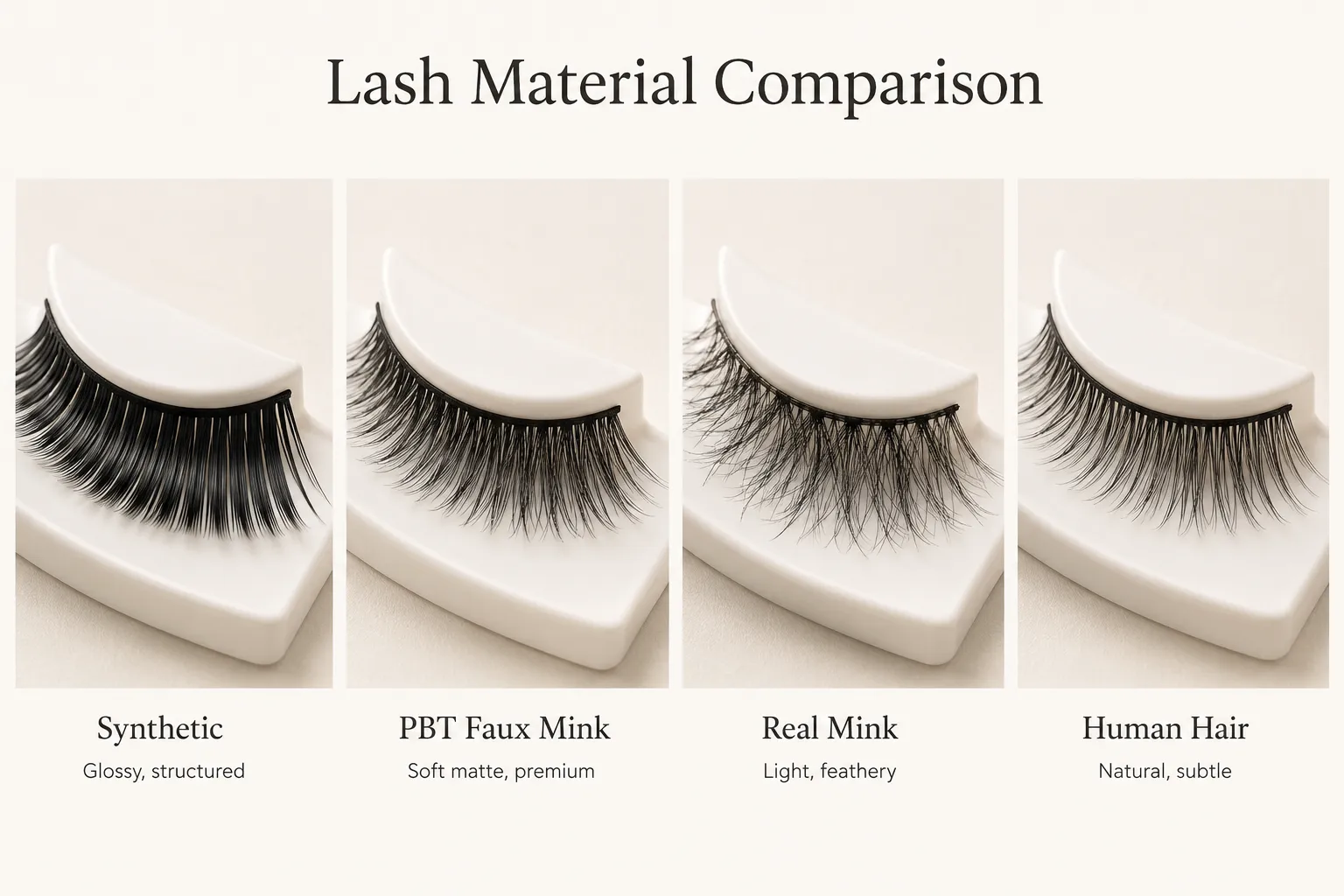
What they look like: Synthetic fibers tend to have a shinier appearance and a more uniform curl than natural materials. This gives them a bold, dramatic finish that works well for statement looks and high-volume styles.
What they feel like: Stiffer than natural materials. The lash band is often firmer, which some wearers find less comfortable for all-day use.
Who they are best for:
- Anyone on a budget who wants a reliable daily lash
- Wearers who prefer dramatic, full-glam styles
- Beginners who are still learning application and want a forgiving, shape-retaining lash
Durability: With proper care (no oil-based removers near the band, gentle storage), a good synthetic lash can be worn 15 to 20 times.
2. PBT Fiber (Faux Mink and Faux Silk)
PBT stands for polybutylene terephthalate, a high-grade thermoplastic polymer that has become the industry standard for premium synthetic lashes. If a lash is marketed as “faux mink” or “faux silk,” PBT is almost certainly what it is made from.
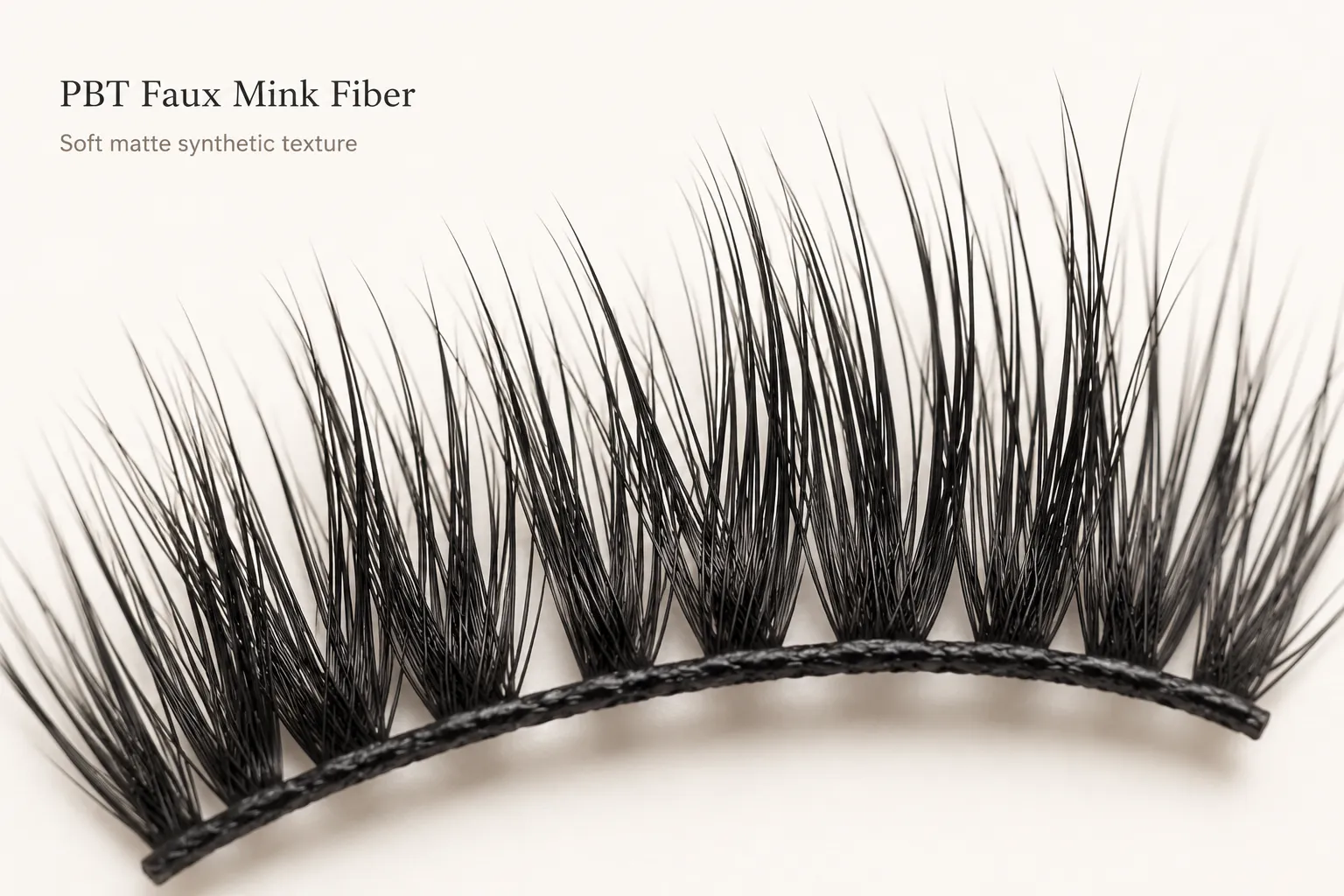
PBT was developed to replicate the properties of real mink fur: soft, matte finish, tapered ends, and lightweight feel. The result is a synthetic material that comes remarkably close to the natural look of real mink without any animal involvement.
What sets PBT apart from basic synthetic fibers:
| Property | Basic Synthetic (Nylon/Polyester) | PBT Faux Mink |
|---|---|---|
| Finish | Shiny | Matte/natural |
| Texture | Stiff | Soft and flexible |
| Curl retention | Strong but uniform | Natural-looking variation |
| Comfort | Moderate | High |
| Price point | Low | Mid |
| Cruelty-free | Yes | Yes |
Why PBT is the preferred material for professional lash extension suppliers: Korean PBT fiber in particular is considered the benchmark for quality in the lash extension industry. Suppliers like those found on Alibaba often specify “Korean PBT” as a mark of quality distinction. If you are sourcing lashes for a business, this is the material to prioritize for everyday extension sets. For more on evaluating suppliers by material quality, see our guide on [best lash vendors on Alibaba].
3. Real Mink Fur
Real mink lashes are made from the tail fur of mink animals, typically sourced from fur farms. They were considered the gold standard in false lashes for many years due to their exceptionally lightweight feel, natural taper, and soft texture that closely mimics human lashes.
What they look like: Very natural. Real mink fibers taper to a fine point the way natural lashes do, creating a result that blends seamlessly with the natural lash line.
What they feel like: Extremely lightweight and barely detectable during wear.
The significant drawbacks:
- Animal welfare concerns: Real mink lashes require animals to be kept in captivity and their fur to be harvested. Major animal rights organizations including PETA have documented welfare concerns at mink fur farms. Many beauty consumers and professionals have moved away from real mink lashes for this reason.
- Cannot be sterilized easily: Because they are animal fur, real mink lashes cannot be fully sterilized without damaging the fiber. This raises hygiene considerations for reuse.
- Price: Real mink lashes carry a significant price premium over synthetic alternatives.
- Not vegan or cruelty-free: This is increasingly a purchasing barrier as consumer values around animal products shift.
Given the advances in PBT fiber technology, most lash professionals and beauty editors now consider high-quality faux mink a comparable or superior alternative for most applications.
4. Human Hair Lashes
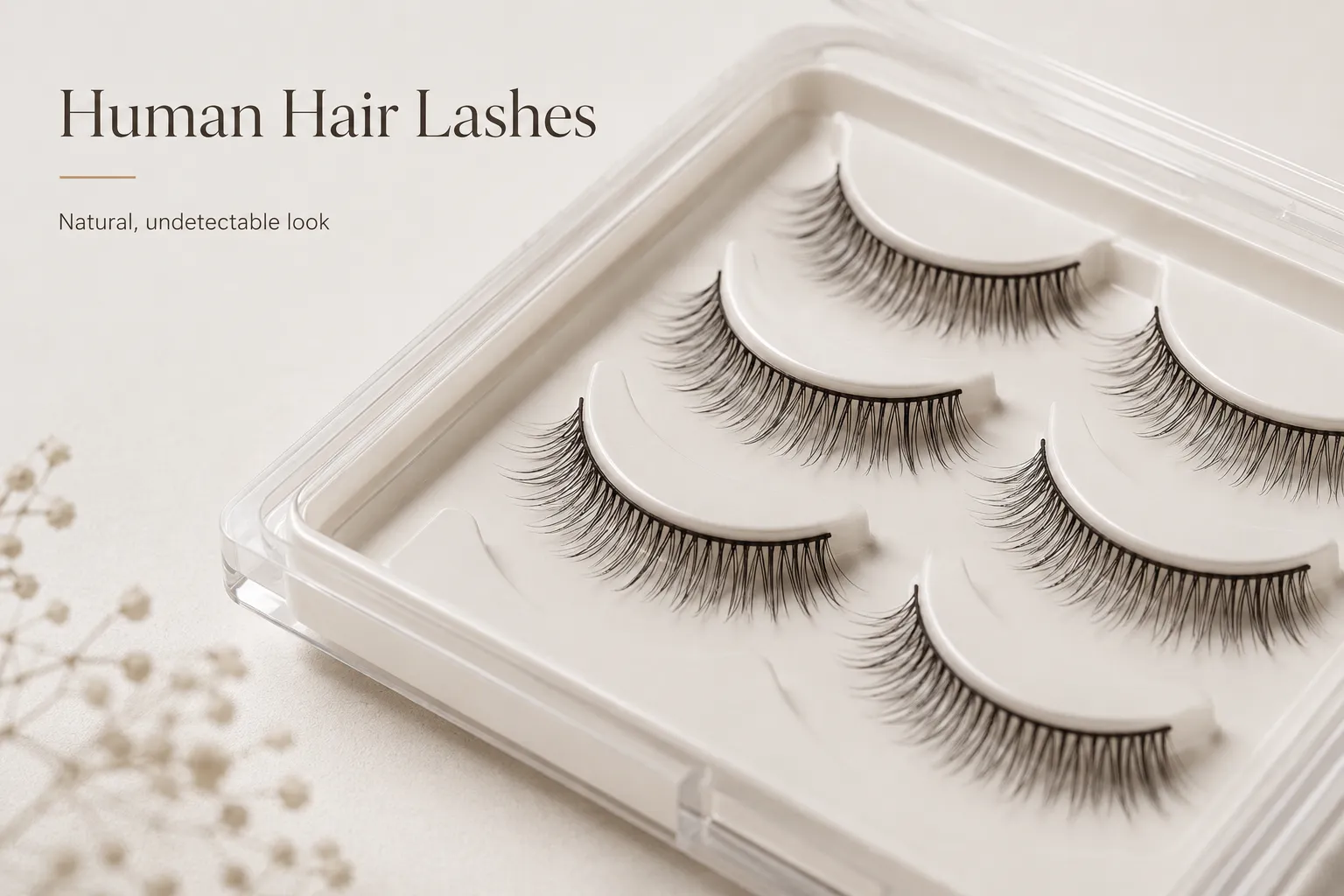
Human hair lashes are made from sterilized, collected human hair. They sit at the premium end of the false lash market and are used primarily by wearers who want the most natural-looking result possible.
What they look like: Because the fibers are actual hair, they behave exactly like natural lashes: varied texture, natural taper, and a finish that requires no adjustment.
What they feel like: Lightweight and flexible, conforming naturally to the curve of the eyelid.
Considerations:
- Higher cost than synthetic options
- Require careful sourcing to ensure ethical hair collection
- Less widely available than synthetic or faux mink options
- Best suited to editorial work, film, and theater where undetectable realism is the priority
5. Magnetic Lashes
Magnetic lashes are a category defined more by their attachment mechanism than their fiber material. The lash fibers themselves are typically synthetic (nylon or PBT), but the band contains a series of tiny rare earth magnets that attach to a magnetic eyeliner worn on the lash line.
Why they have grown in popularity:
- No adhesive required, which eliminates glue allergy risk
- Reusable with minimal degradation to the magnet or fiber
- Faster application once the technique is learned
- Cruelty-free by default (fibers are synthetic)
The tradeoff: The magnet-embedded band is slightly heavier and less flexible than a cotton band, which some wearers notice during all-day wear. Application also requires practice since the magnets snap into place quickly and positioning needs to be precise.
Brands like Ardell and Glamnetic have made magnetic lash systems widely accessible at various price points.
Lash Band Materials: The Detail Most People Overlook
The fiber gets most of the attention, but the band is what determines comfort during wear. Two types are most common:
Synthetic Plastic Band
Found on budget-friendly strip lashes. Rigid and uniform, which makes the lash easy to handle during application but less comfortable over long wear periods. The firmness can also make the band more visible at the lash line if not set precisely.
Cotton Thread or Clear Band
The preferred option for comfort and discretion. Cotton thread bands are thin and flexible, conforming to the natural curve of the eyelid rather than fighting against it. A clear or invisible band disappears at the lash line, making the finished look cleaner and more natural.
If you plan to wear lashes for extended periods or have a more curved eye shape, a cotton or clear band lash is significantly more comfortable than a plastic strip.
Adhesive Materials: What Holds Lashes in Place
Latex-Based Glue
The most widely used adhesive for strip lashes. Latex-based glues dry clear or black and are available at most drugstores. The key consideration: latex allergies are not uncommon, and anyone with a known latex sensitivity should look for a latex-free alternative.
Latex-Free Adhesives
Formulated for sensitive eyes and latex-allergic wearers. Brands like DUO Brush-On Lash Adhesive offer latex-free formulas that perform comparably to standard versions.
Cyanoacrylate (Lash Extension Adhesive)
Used exclusively for professional lash extensions, not strip lashes. Cyanoacrylate creates a semi-permanent bond between the extension and the natural lash, which is why extension adhesive requires professional application and specific removal techniques. This is a different product entirely from strip lash glue.
Which Fake Lash Material Is Right for You?
There is no single best material. The right choice depends on what you are optimizing for:
Choose PBT Faux Mink if:
- You want a natural look without animal products
- You are building a lash vendor catalog and need a reliable everyday material
- You or your clients have sensitive eyes and need a hypoallergenic option
Choose Basic Synthetic if:
- Budget is the primary consideration
- You prefer bold, dramatic styles with strong curl retention
- You are a beginner building your lash application skills
Choose Human Hair if:
- You need the most natural, undetectable result possible
- You are working in editorial, film, or theater contexts
Choose Magnetic Lashes if:
- You have a latex allergy or sensitivity to lash adhesives
- You want a reusable system with no glue application
Avoid Real Mink if:
- Animal welfare is important to you
- You are building a brand that appeals to vegan or cruelty-free consumers
Frequently Asked Questions
Are fake lashes safe for sensitive eyes?
PBT synthetic lashes are generally considered hypoallergenic and are a good choice for sensitive eyes. The adhesive is more often the source of irritation than the lash fiber itself. If you have a latex allergy, use a latex-free lash glue.
What is faux mink made of?
Faux mink lashes are made from PBT (polybutylene terephthalate) fiber, a high-grade synthetic material engineered to mimic the softness and matte finish of real mink fur. They are cruelty-free and vegan.
How many times can you reuse fake lashes?
It depends on the material and care. Basic synthetic lashes last 5 to 10 wears. PBT faux mink lashes can last 15 to 25 wears with gentle handling. Magnetic lashes typically last 30 to 60 wears as the magnet does not degrade with use.
Are real mink lashes worth it?
For most wearers, high-quality PBT faux mink offers a comparable result without the ethical concerns or price premium of real mink. Real mink lashes have largely been replaced by faux mink in professional settings.
What is the most comfortable fake lash material?
PBT faux mink lashes with a cotton thread or clear band are widely considered the most comfortable option for extended wear. The fiber is soft and lightweight, and the flexible band conforms to the natural eyelid curve.
Final Thoughts: What Are Fake Lashes Made Of?
Understanding lash materials gives you a genuine advantage whether you are a consumer choosing your next pair, a lash artist advising clients, or a vendor building a product line.
The quick summary:
- Basic synthetic (nylon/polyester): Affordable, durable, dramatic finish, slightly stiff
- PBT faux mink: Best all-round option, soft, matte, hypoallergenic, cruelty-free
- Real mink: Natural look, but expensive and ethically controversial
- Human hair: Most natural result, premium price, best for editorial use
- Magnetic lashes: Glue-free, reusable, good for adhesive-sensitive wearers
The lash industry has moved decisively toward PBT fiber as the quality standard for good reason. It delivers a natural look, performs reliably, works for sensitive eyes, and involves no animal products. For most purposes, it is the material worth centering your choices around.
